

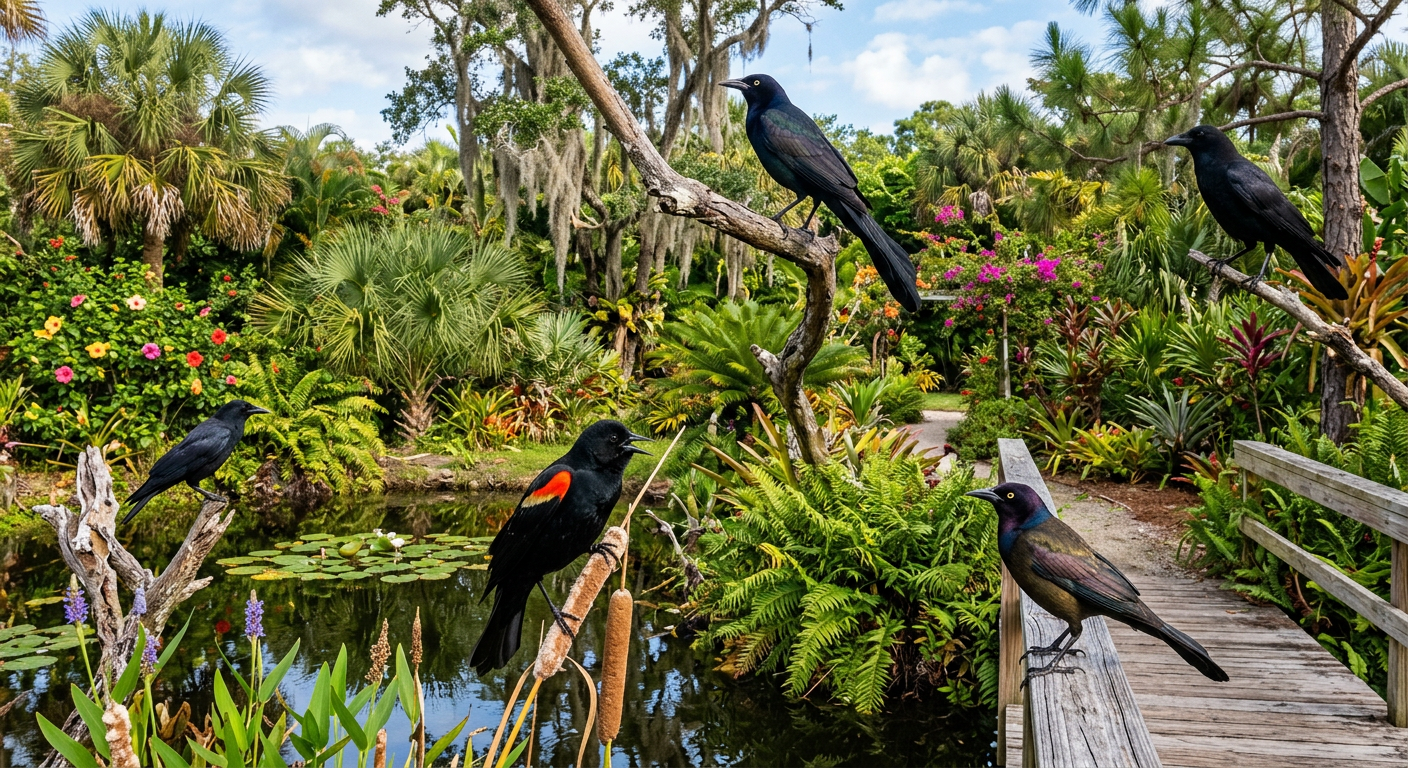
All Black Everything
You see a glossy dark bird strutting across your lawn. Is it a blackbird, a grackle, or a crow? In South Florida, the answer is rarely obvious — and it matters more than you think.
South Florida has no shortage of bold, dark-feathered birds. They colonize shopping center parking lots, wade through canal edges at golden hour, and fill royal palms with raucous noise every dusk. Most people call all of them “blackbirds” and move on. But look closely and you’ll find five very different birds — each with its own personality, its own role in the ecosystem, and its own way of making itself known. The trick is knowing what to look for.
This guide focuses on the species you’re most likely to encounter in the greater South Florida landscape: the Red-winged Blackbird, the Common Grackle, the Boat-tailed Grackle, the American Crow, and the Fish Crow. Each belongs to a different family, occupies a different niche, and gives you very different field marks to work with once you know the clues.
“Once you learn to tell these birds apart, you’ll realize South Florida’s skies are far more crowded — and far more interesting — than they first appeared.”
The Cast
Five Birds, One Confusion
Before we dig into field marks and behavior, it helps to understand the fundamental family split. Blackbirds and grackles are icterids — members of the same family as orioles, cowbirds, and meadowlarks. Crows are corvids, closely related to ravens, jays, and magpies. These are not just distant relatives; they come from entirely different evolutionary branches. The resemblance in color is coincidence, not kinship.
Red-winged Blackbird
Year-round
Wetlands
The most straightforward ID in the group. Males are jet black with unmistakable red-and-yellow shoulder patches — epaulets they flash aggressively during territorial disputes. Females are a streaky brown, often mistaken for a large sparrow. Their song, a liquid conk-la-ree, is one of the most recognized sounds in Florida’s marshes and wet meadows. In winter, they form enormous mixed flocks with other blackbirds across agricultural fields.
Common Grackle
Year-round
Suburban
A lanky, long-tailed bird with a distinctive keel-shaped tail and piercing pale yellow eyes. In good light, males flash extraordinary iridescence — bluish-purple on the head, bronzy-green on the body. The Florida subspecies (sometimes called the “purple grackle”) leans toward a deeper green-and-purple sheen rather than bronze. They love open lawns, parking lots, and bird feeders, where they stride with confident long-legged steps rather than hopping. The call is a harsh, mechanical squeak, often compared to a rusty gate.
Boat-tailed Grackle
Year-round
Coastal
The largest and loudest of the group. Males are dramatically longer than Common Grackles, with a sail-like tail that makes up nearly half their body length — held folded in a distinctive V-shape, like a boat’s keel. Adult males are glossy black with an iridescent purple-blue head. Crucially, in Florida the Boat-tailed Grackle has dark eyes, not yellow, which is a key distinction from Common Grackles. Females are a warm russet-brown — almost a different species in appearance. Their calls are extraordinary: a wild medley of gurgling squeals, rattles, and jet-engine screeches delivered from conspicuous perches.
American Crow
Year-round
Widespread
Significantly larger than any grackle — closer in size to a small hawk. All black, with a heavy, thick bill that is noticeably robust compared to the slender bill of a grackle. The tail is broad and square when fanned. American Crows fly with steady, purposeful wingbeats and rarely idle. Their classic deep caw-caw-caw, delivered with the head bobbing, is unmistakable once learned. Highly intelligent and social, they often mob raptors and move in tight family groups. In South Florida, the local race (C. b. pascuus) tends to have notably large feet.
Fish Crow
Year-round
Coastal/Water
Visually almost identical to the American Crow — and that’s the trap. The Fish Crow is about 20% smaller, with a slightly slimmer bill and silkier plumage with a blue-green sheen. In South Florida it is likely the more common crow you’ll see along canals, mangrove edges, and coastal parks. The only reliable field mark at a glance is the call: a short, nasal, two-note uh-uh or uh-oh, strikingly different from the American Crow’s full-throated caw. Fish Crows are also water-oriented foragers, often wading in shallows or working tide lines for crabs, fish, and invertebrates.
Field Reference
The Quick-Look Comparison
When you have seconds to make an ID — which is usually the case — knowing the two or three sharpest field marks for each bird pays off immediately. Here’s the cheat sheet:
| Bird | Size | Key Visual | Eyes | Tail Shape | Call |
|---|---|---|---|---|---|
| Red-winged Blackbird | Robin-sized | Red-yellow shoulder patch (males); streaky brown females | Dark | Short, flat | Conk-la-ree |
| Common Grackle | 11–13 in. | Iridescent purple-bronze body; long keel tail | Pale yellow | Long, keeled | Rusty-gate squeak |
| Boat-tailed Grackle | 12–16 in. | Massive V-shaped tail (male); russet-brown females | Dark (in FL) | Very long, V-keel | Gurgling squeals & rattles |
| American Crow | 17–21 in. | Heavy, thick bill; broad square tail; large body | Dark brown | Square, rounded | Deep caw-caw-caw |
| Fish Crow | 14–16 in. | Near-identical to Am. Crow but smaller & slimmer bill | Dark brown | Square, rounded | Nasal uh-uh |
Let Your Ears Do the Work
For three of these five birds, voice is the fastest — and sometimes only — reliable ID tool. Train your ear on these signatures.
In the Field
Where to Look — and Why It Matters
Habitat is your first filter. If you’re scanning a freshwater marsh, pond edge, or sugarcane field, the black bird swaying on a cattail stem is almost certainly a Red-winged Blackbird. If you’re in a coastal mangrove tangle or along a tidal creek, the bird wading through the shallows is likely a Fish Crow working the tide line, or possibly a Boat-tailed Grackle. If you’re watching a Walmart parking lot at dusk, the noisy gathering in the light standards is almost certainly dominated by Common Grackles and Boat-tailed Grackles, and you may find them mixed with European Starlings and Brown-headed Cowbirds.
Crows tend to stay more deliberately aloof. American Crows command open spaces — agricultural fields, suburban parks, roadside verges — and usually move in purposeful family groups rather than the sprawling mixed-species flocks that grackles favor. Fish Crows will casually raid the nests of herons, ibis, and terns along canals and coastal impoundments. If you see a crow-sized black bird pulling a heron chick from a nest in the Everglades, it’s almost certainly a Fish Crow.
Boat-tailed Grackles are the masters of coastal Florida. Though they occur inland throughout the peninsula (unique to Florida compared to the rest of their Gulf Coast range), they’re most abundant and theatrical in the salt marshes, mangrove edges, and waterfront parks. During breeding season, male Boat-taileds perform elaborate display flights from conspicuous perches — wings spread, tail fanned into that dramatic V — while females conduct all the actual nesting work in dense waterside vegetation.
Standing in a South Florida parking lot surrounded by dark birds? If the flock is tightly packed and very noisy at dusk, you’re almost certainly looking at Common Grackles and Boat-tailed Grackles. Crows rarely roost in those chaotic mixed-species flocks — they’re more socially exclusive. If a single large bird breaks from the group and lands alone on a light pole to watch the scene, that’s probably your crow.
Advanced ID
The Crow Problem: When Two Crows Look Like One
The Fish Crow is one of North America’s most underappreciated bird identification puzzles. Visually, it is nearly impossible to separate from the American Crow under normal field conditions. Both are entirely black, both have the same broad crow shape, and both can be seen in South Florida throughout the year. Even experienced birders admit that visual differentiation is “extremely difficult and often inaccurate” without a direct size comparison.
The solution is always voice. The American Crow’s familiar call is a deep, resonant, full-throated caw — authoritative and loud. The Fish Crow’s call is a short, nasal two-note uh-uh or uh-oh, almost questioning in quality, like a polite disagreement. Once you hear both side by side, you’ll never confuse them again. In South Florida, where Fish Crows tend to dominate coastal and waterside habitat, default to Fish Crow when you’re near water until the bird calls and tells you otherwise.
There are subtle visual clues, but use them carefully. Fish Crows have slightly more lax upper-back feathers that lack the “scaled” or ringed effect visible on American Crows in good light. Fish Crows also show a slightly slimmer, more pointed bill and tend to look shorter-legged when walking. But these are fine distinctions that won’t save you in the field without practice. The call remains the gold standard.
“In South Florida, the default rule near water is: if it calls like a question, it’s a Fish Crow. If it calls like a statement, it’s an American Crow.”
In Your Garden
These Birds in Your Backyard
For South Florida gardeners and outdoor living enthusiasts, these birds aren’t just a curiosity — they’re a daily presence that interacts with your outdoor space in surprisingly direct ways.
Grackles at the feeder are a mixed blessing. Common Grackles are dominant, aggressive feeders that will displace smaller birds from platform feeders and scatter seed everywhere. If grackle flocks are overwhelming your setup, tube feeders with small perches, or weight-activated perches that close under heavier birds, can help. Boat-tailed Grackles are less interested in dry seed and more focused on insects, crustaceans, and anything near your pond or water feature.
Crows and garden health have a more complex relationship. American and Fish Crows are opportunistic omnivores that will take eggs from other nesting birds in your yard, which can frustrate those who attract songbirds. But they also consume enormous quantities of grubs, beetles, and other soil insects — making them genuine allies for vegetable gardeners battling lawn pests. A crow working across a freshly turned garden bed is acting as a very effective pesticide-free pest control service.
Red-winged Blackbirds are largely beneficial in the garden context, consuming enormous quantities of insects, weed seeds, and crop pests. Their preference for wet edges and reedy vegetation means they’re especially common in yards near canals, retention ponds, or rain gardens — South Florida features that are increasingly common in sustainable landscape design.
Want to attract a diverse mix of these birds without the feeder battles? A shallow water feature — even a wide, low-rimmed birdbath or a slow-drip fountain — will bring in all five species reliably, on their own terms, with far less competition than a seed feeder creates.
Final Word
Stop Calling Everything a Blackbird
The next time a dark bird struts across your lanai, pause for three seconds. Note the size — is it crow-big, or more robin-to-dove sized? Check the tail — is it long and keel-shaped, or compact and square? If you can hear it, listen. That single call will do more work than any field mark.
South Florida’s dark birds are a microcosm of the state’s broader biodiversity — visible, abundant, and often ignored because they look so similar at a glance. Each species has carved out a specific niche in the peninsula’s mosaic of mangroves, marshes, suburbs, and shorelines. Learning to tell them apart is one of the most rewarding small skills a South Florida outdoor enthusiast can develop — and you’ll be surprised how quickly it transforms an ordinary backyard afternoon into something worth paying attention to.
Free birding apps including Merlin Bird ID (Cornell Lab) and eBird are excellent resources for learning calls and confirming sightings in South Florida.