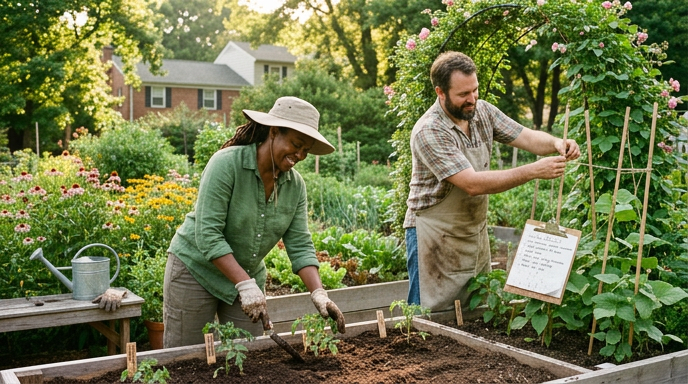
June in Maryland is the month of no excuses. The frosts are gone, the soil is warm, and your local garden centers are still stocked. From the Eastern Shore’s humid heat to the cooler ridge country of Western Maryland and the clay-heavy suburban lots of the DC suburbs, the Mid-Atlantic in June is full of gardening momentum — but it rewards the attentive and punishes the forgetful. Pests are rising, weeds are sprinting, and summer vegetables need your attention right now.
Whether you’re tending a backyard food garden in Howard County, maintaining perennial borders in Annapolis, or coaxing tomatoes along in a Frederick County raised bed, this list has you covered. Work through it zone by zone and garden type — and don’t skip the “act now” items at the top.
⚠ Don’t wait on these
Your first week in June matters most
In the Mid-Atlantic, the window between “perfect planting weather” and “brutal heat stress” closes fast. Early June gives you the best shot at establishing new plants, getting warm-season crops in the ground, and getting ahead of the weed and pest season before it takes over. Do the urgent tasks in the first 7–10 days of the month.
Finish warm-season planting — now or wait until next year
Do Now
By mid-June, soil temps in most of Maryland are solidly 65–75°F — ideal for setting out transplants of tomatoes, peppers, eggplant, cucumbers, squash, and melons. Don’t push past June 15 for heat-loving crops; anything planted later in our region struggles to mature before fall frost cutoff. If you’re starting from seed rather than transplants, stick to fast-maturing cucumbers and summer squash.
Direct sow beans and okra
June is prime time for succession plantings of green beans (bush or pole) — they mature in 50–60 days, giving you a harvest before August heat sets in. Okra loves heat and is a natural fit for Maryland’s hot, humid summers; direct sow now and thin to 12 inches. A second sowing of beans in late June sets you up for a fall harvest too.
Watch for squash vine borers — peak emergence is June
Act Fast
The squash vine borer moth (Melittia cucurbitae) emerges from the soil in late May through June across Maryland, laying eggs at the base of squash and zucchini stems. Check the base of each plant daily for tiny, flat red-brown eggs. Row covers before flowering and wrapping stems with aluminum foil at the base can deter egg-laying. Once larvae are inside the stem, control is very difficult.
Mulch vegetable beds now, before the heat
A 2–3 inch layer of straw or untreated wood chip mulch around vegetable plants conserves soil moisture, moderates root temperature, and dramatically cuts down on weeding. In Maryland’s typically hot and dry July–August, adequate mulch can be the difference between a productive garden and a stressed one. Apply before the ground gets bone dry.
Plant sweet potato slips — a Maryland summer staple
Maryland Pick
Sweet potatoes need 90–120 days of warm weather and do exceptionally well in Maryland’s longer-summer areas (Eastern Shore, Southern Maryland, Baltimore metro). Plant slips in early June for a late September–October harvest. They’re low-maintenance once established and tolerate the heat beautifully. Try ‘Beauregard’ or ‘Covington’ for reliable Mid-Atlantic performance.
Pinch suckers and stake tomatoes aggressively
Indeterminate tomato varieties will grow into a tangled mess by mid-summer if you let them. Pinch off suckers (shoots growing from the crotch between stem and branch) regularly and tie main stems to sturdy cages or stakes. The goal is good airflow — especially critical in Maryland’s humid summer, which creates perfect conditions for early blight and septoria leaf spot.
🌱 Direct Sow in June — Mid-Atlantic
Still plenty to start from seed this month
Bush Beans
Pole Beans
Okra
Summer Squash
Cucumbers
Basil
Dill
Sweet Potato Slips
Edamame
Lima Beans
Sunflowers
Cosmos
Deadhead spent spring perennials to encourage rebloom
Salvia, catmint, coreopsis, and many campanula varieties will push out a second flush of blooms if you cut them back by one-third after the first wave fades. Don’t just pull off individual blooms — shear the whole plant back to fresh foliage for the best regrowth response. In Maryland, this usually means cutting back in late May through early June.
Plant summer annuals — you have a great window now
Zinnias, marigolds, celosias, portulaca, vinca (Catharanthus), and gomphrena all thrive in Maryland summers and can be planted through mid-June. These are your workhorses for color from now through hard frost. Avoid impatiens in sunny spots — downy mildew has been widespread in the region since the early 2010s. Try New Guinea impatiens or SunPatiens instead.
Plant native coneflowers and black-eyed Susans
Maryland Native
Echinacea purpurea and Rudbeckia hirta are Maryland natives that bloom reliably in June and July with virtually no care. They’re drought-tolerant once established, beloved by bees and butterflies, and the dried seed heads feed birds into winter. Black-eyed Susan is actually Maryland’s state flower — a natural fit for any Mid-Atlantic garden. Plant transplants now or direct sow Rudbeckia for late summer blooms.
Cut back bearded irises and divide overcrowded clumps
After bloom fades (usually late May–early June), cut iris foliage back to a fan shape about 6 inches tall. If your clumps are dense and blooming is thin, this is a perfect time to dig and divide — irises actually prefer division in summer. Replant the youngest rhizomes from the outer edges; discard the woody centers. Share extras with neighbors or pot them up.
Stop fertilizing cool-season lawns NOW
Stop
If your Maryland lawn is turf-type tall fescue, Kentucky bluegrass, or fine fescue (the most common cool-season grasses in the region), do not apply fertilizer in June. Summer fertilization on cool-season turf pushes lush, disease-prone growth right when heat stress is highest. Feeding now is one of the most common ways homeowners inadvertently weaken their lawns. Next feeding window: Labor Day.
Raise mowing height to 3.5–4 inches
Taller turf shades the soil, keeps roots cooler, and outcompetes crabgrass and other summer weeds. Most Mid-Atlantic lawn care pros recommend never cutting cool-season grasses below 3 inches in summer. Mow frequently enough that you’re never removing more than one-third of the blade height in a single cutting. Dull blades tear grass tissue and increase disease risk — sharpen or replace before the summer season.
Let fescue go semi-dormant — it’s normal
Good to Know
Tall fescue lawns across Maryland commonly go tan or brown in July–August during heat and drought — this is natural dormancy, not death. Avoid overwatering to “keep it green,” which can lead to brown patch fungus. A deep soak once a week (about 1 inch) is far better than shallow daily watering. The lawn will green back up in September when temperatures drop and fall rains return.
Water newly planted trees and shrubs deeply
Anything planted in the last 12 months — trees, shrubs, evergreens — needs consistent, deep watering through its first summer. The rule of thumb: 10 gallons per inch of trunk diameter, once or twice per week during hot, dry spells. Don’t rely on rainfall alone in Maryland’s summer. A slow trickle from a hose for 30–45 minutes directly at the root zone beats a quick sprinkler pass every time.
Watch for spotted lanternfly — report and destroy
Invasive Alert
Spotted lanternfly (Lycorma delicatula) is now firmly established across Maryland and peak nymph season runs June through August. Look for red-spotted black nymphs on tree-of-heaven, grapes, hops, apples, and many ornamental trees. Scrape egg masses, crush nymphs, and report sightings to the Maryland Department of Agriculture. This invasive species threatens the state’s grape, apple, and hops industries — every adult killed matters.
Hold off on major pruning of spring-blooming shrubs
Azaleas, mountain laurel, rhododendrons, lilac, and forsythia set next year’s flower buds on old wood within 4–6 weeks after blooming. If you didn’t prune them right after bloom (late April–May), don’t do it now — you’ll cut off 2027’s flowers. Wait until next spring, immediately post-bloom, for any needed shaping. Emergency removal of dead or damaged branches is always fine year-round.
Plant crape myrtles and butterfly bush for summer color
Zone 7b Pick
In Southern Maryland, the Baltimore metro, and Eastern Shore (Zone 7a–7b), crape myrtles reliably overwinter and deliver spectacular summer bloom. Early June planting gives them time to establish before peak heat. Butterfly bush (Buddleia) is reliable throughout Zone 6b–7b and starts blooming in mid-summer, drawing in monarchs, swallowtails, and hummingbirds. Choose sterile or low-seed cultivars to prevent aggressive self-seeding.
Maryland spans nearly three USDA hardiness zones, which means June gardening varies meaningfully depending on where you are. Here’s a quick breakdown:
| Region |
Zone |
June Notes |
Western Maryland
Garrett, Allegany counties |
6a–6b |
Last frost risk into early May; June is your true planting start for warm-season crops. Watch for late-season cold snaps in the mountains. Shorter growing season — prioritize fast-maturing varieties. |
Piedmont / Central MD
Frederick, Carroll, Howard, Baltimore |
6b–7a |
Classic Mid-Atlantic summer in full swing by mid-June. Heat and humidity build fast. Great tomato and pepper weather through August. Heavy clay soils common — amend and mulch heavily. |
DC Suburbs / Metro
Montgomery, Prince George’s, Anne Arundel |
7a–7b |
Urban heat island effect means warmer nights and earlier heat. Excellent for crape myrtles and fig trees. Deer pressure is intense in suburban areas — plan accordingly for any new plantings. |
Eastern Shore
Talbot, Dorchester, Worcester counties |
7a–7b |
High humidity and coastal influence. June is excellent for sweet potatoes and watermelons. Watch for fungal diseases on tomatoes — airflow and copper sprays help. Great sunflower and cut-flower region. |
Southern Maryland
Calvert, St. Mary’s, Charles counties |
7b |
Warmest zone in the state. Tropical and subtropical plants like crape myrtle, hardy banana, and elephant ear overwinter here. June is the start of peak growing season — plant aggressively. |
Japanese beetle season begins mid-June
Heads Up
Maryland is firmly in the Japanese beetle belt, and adults typically emerge between June 15–July 1 depending on soil temps. They’ll skeletonize rose, grape, crape myrtle, and linden foliage in days. Hand-pick into soapy water in the morning when beetles are sluggish. Avoid Japanese beetle traps — research consistently shows they attract more beetles to your yard than they trap. Neem oil and pyrethrin-based sprays can knock populations down.
Scout for aphids on roses, milkweed, and vegetables
June warm-up triggers aphid population explosions. Check the undersides of leaves on roses, tomato transplants, and kale. A strong blast of water from the hose dislodges most aphids effectively without pesticide. Encourage ladybugs and lacewings by avoiding broad-spectrum insecticide sprays. If population pressure is high, insecticidal soap is effective and low-impact.
Check boxwood for boxwood blight and leafminer
Boxwood blight (Calonectria pseudonaviculata) has spread throughout the Mid-Atlantic and is most active in warm, humid conditions — exactly what Maryland gets in June. Look for circular brown spots on leaves and black streaking on stems. Boxwood leafminer causes blistered, discolored foliage. Both have increased significantly in Maryland over the past decade; consider transitioning high-blight-risk areas to native alternatives like inkberry holly (Ilex glabra).
June is the month that separates the planners from the reactors. The gardeners who mulched early, staked their tomatoes before they flopped, and got ahead of the weed line in the first week will have an easier summer. The ones who waited until the heat settled in will spend July and August playing catch-up.
Maryland’s range of climates — from the cool, forested western mountains to the hot and humid Eastern Shore — means there’s always something to grow, something blooming, and something demanding attention. Embrace the mess of June. It’s the most alive your garden will be all year.
Come back next month for the July edition: managing heat stress, midsummer harvests, and what to start now for a fall vegetable garden.
Dig Magazine · digmagazine.com
June 2026 · Mid-Atlantic Edition