
Mind | Body | Dirt is, at its heart, a column about paying attention — to soil, to breath, to the quiet systems that keep a thing alive. So when a reader wrote in asking whether I’d ever had my Human Design chart done, I didn’t have a tidy answer. I had curiosity, and a free afternoon.
If you haven’t encountered it, Human Design is one of those wellness-adjacent systems that borrows a little from everywhere — astrology’s birth-moment precision, the I Ching’s 64 hexagrams, the chakra system’s energy centers — and stitches them into something called a bodygraph. Plug in your birth date, time, and place, and out comes a diagram: nine geometric shapes (“centers”), some shaded in, some left open, connected by lines (“channels”) that are supposed to describe how you’re wired to move through the world.
I want to be upfront about something before I go further: this isn’t science. There’s no peer-reviewed research behind it, and psychologists don’t treat it as a validated framework for personality or decision-making. What it is, at best, is a mirror — a structured way to ask yourself questions you might not otherwise ask. I went in treating it exactly that way.
My Chart, For What It’s Worth
My type came back as a Generator — supposedly the most common type, representing something like two-thirds of people. Generators are described as the workhorses of the system: steady, sustainable energy, built to respond to what shows up rather than to chase and initiate. The suggested strategy is disarmingly simple — respond. Wait for something to knock, then decide whether it’s a yes.
My authority — the part of the chart that claims to know how I make good decisions — landed on the Sacral, which is described less as a thinking process and more as a gut-level yes or no. Not “let me sleep on it.” Something closer to the way you know, hand hovering over a tomato at the market, whether it’s ripe before you’ve consciously registered why.
The profile came out 2/4 — nicknamed the Hermit/Opportunist. The 2 side wants solitude and deep, private focus; the 4 side needs a small, trusted network of people to be pulled out into the world through. Reading that, I laughed a little. That’s more or less my writing life in a sentence: weeks alone with a manuscript, then leaning entirely on a handful of people to get it anywhere.
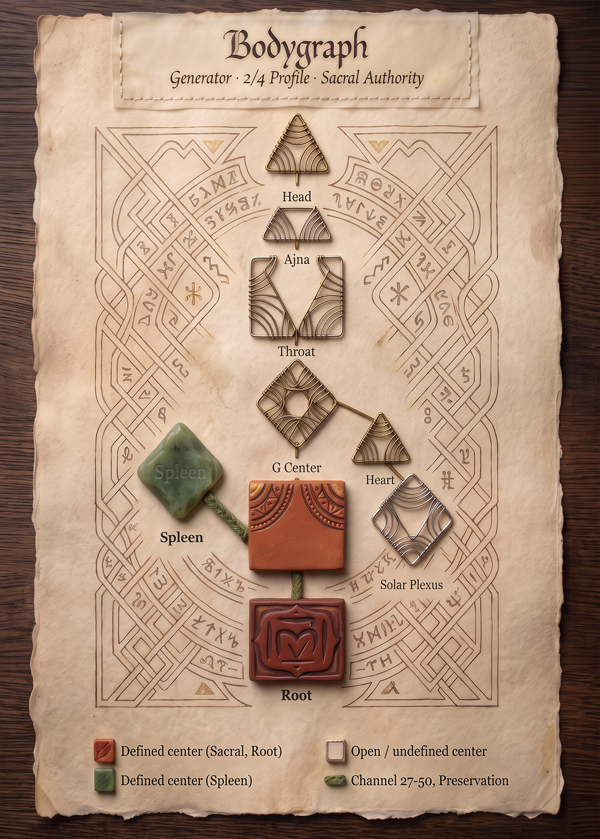
Three centers came back “defined” — Sacral, Root, and Spleen — with the rest left open. In this system, open centers aren’t a flaw; they’re where you’re said to absorb energy from others, for better or worse. My open Head and Ajna, apparently, mean I can be a sponge for other people’s thoughts and worries if I’m not careful about whose voice I’m standing near.
And there was one named channel connecting my Sacral and Spleen — the Channel of Preservation, tied to nurturing and caretaking, an instinct for looking after what’s fragile until it can stand on its own.
Where the Garden Comes In
I’ll admit the caretaking language landed differently for me because of where I spend my mornings. There’s a version of “respond, don’t initiate” that maps almost exactly onto how I’ve learned to garden well. You don’t force a seedling. You watch, you notice what’s asking for water or shade or more room at the root, and you answer it. The plants that have done best under my hands are the ones I stopped trying to will into a shape and started simply responding to.
Whether that’s my Sacral authority at work or just what a decade of trial and error teaches anyone who gardens long enough, I genuinely can’t say. That’s the honest tension at the center of this whole exercise — the chart gave me language for something I already knew about myself, but it didn’t teach it to me. I’m not sure a chart can.
So, Worth Doing?
If you’re the kind of person who likes frameworks — enneagram, astrology, Myers-Briggs — Human Design will feel familiar, and it costs nothing but twenty minutes and your birth details to generate one. Just hold it the way you’d hold any horoscope: as a prompt for reflection, not a diagnosis. The value isn’t in the accuracy of the gates and channels. It’s in the pause it forces — a chance to ask does this sound like me, and if not, why not?
That question, it turns out, is a pretty good one to bring into the garden, too.