
Emerging research — including a 2026 transdisciplinary consortium paper — draws a direct line from soil biodiversity through food quality to gut composition to mood, which is a story only a magazine focused on ‘mind, body, and dirt’ could tell with full authority.
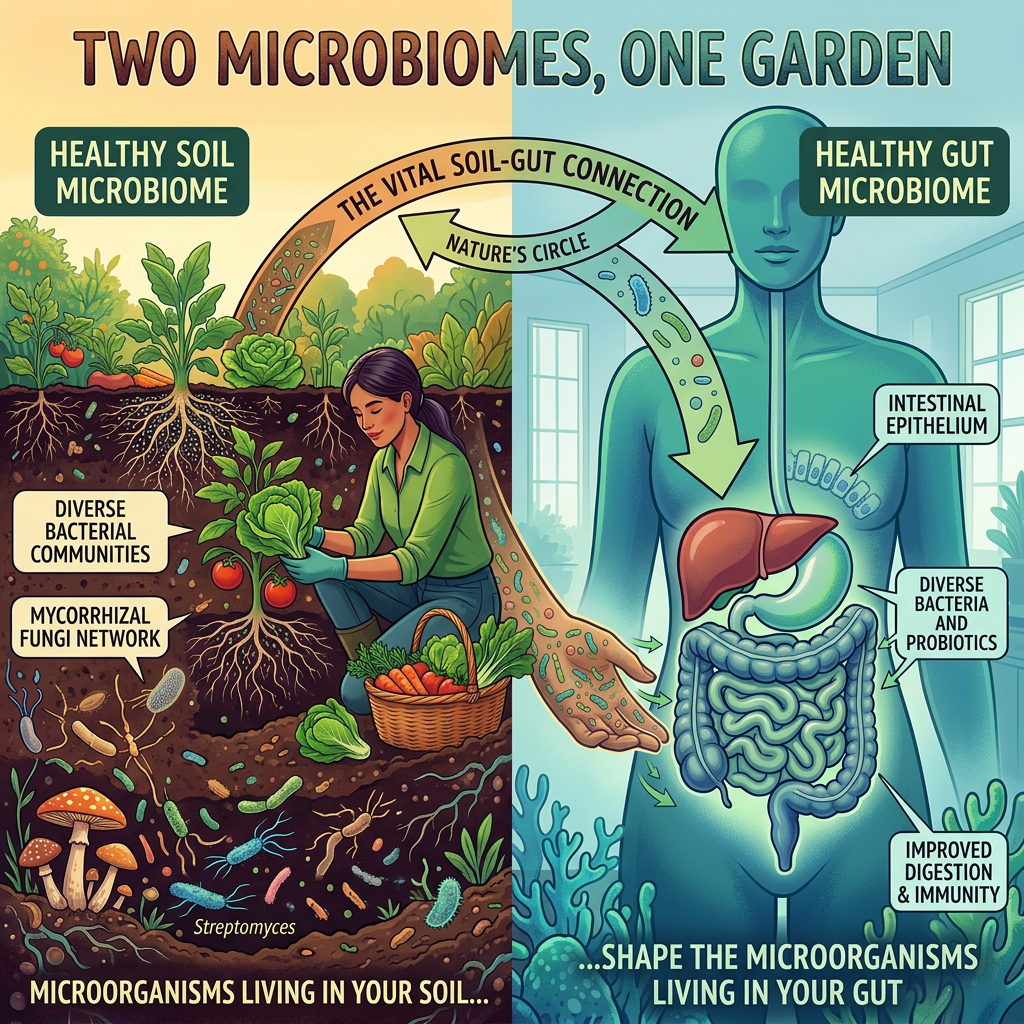
There’s a feedback loop most of us never think about: the microorganisms living in your soil shape the microorganisms living in your gut, and the ones in your gut have a measurable influence on your mood, your anxiety baseline, and how clearly you think. This isn’t folk wisdom dressed up in scientific language — researchers working at the intersection of soil ecology, nutritional biochemistry, and psychobiology have been mapping the mechanism for years. What the 2026 consortium findings add is a clearer picture of the pathway: biologically diverse soil produces plants with a broader and more complex phytochemical profile, and that complexity appears to be what feeds a diverse gut microbiome, which in turn supports the synthesis of neurotransmitters like serotonin and GABA. Simplified soils — those depleted by tillage, synthetic fertilizers, and monoculture — produce simplified plants, which feed a less diverse gut, which correlates with higher rates of mood dysregulation. The chain is longer than we once thought, and your garden sits at the very beginning of it.
What this means practically is that how you tend your soil matters as much as what you plant in it. Gardeners who add compost, avoid compaction, let sections go partly wild, and rotate crops aren’t just following good horticultural advice — they’re actively increasing the biological complexity of the system that will eventually interact with their body. Mycorrhizal networks in particular have become a focus: these fungal threads connect root systems and help plants pull minerals and secondary metabolites from the soil more efficiently. A plant grown in a network-rich, living soil develops a more complete nutritional and phytochemical profile than the same variety grown in sterile or depleted conditions. The vegetable at the end of that chain — even the same species, harvested the same week — is not the same food.
The most interesting implication for readers who grow even a small amount of their own food is this: you don’t need acreage to participate in this loop. Container gardens built with high-quality compost, no-dig beds, even a kitchen herb planter kept deliberately lively with worm castings can shift the quality of what you’re eating. The goal isn’t perfection or self-sufficiency — it’s biological richness, at whatever scale you have. Tending that richness is, quite literally, tending your own nervous system from the outside in. For a magazine whose tagline is *mind, body, and dirt*, this is the story where all three pillars aren’t just adjacent — they’re chemically continuous.