

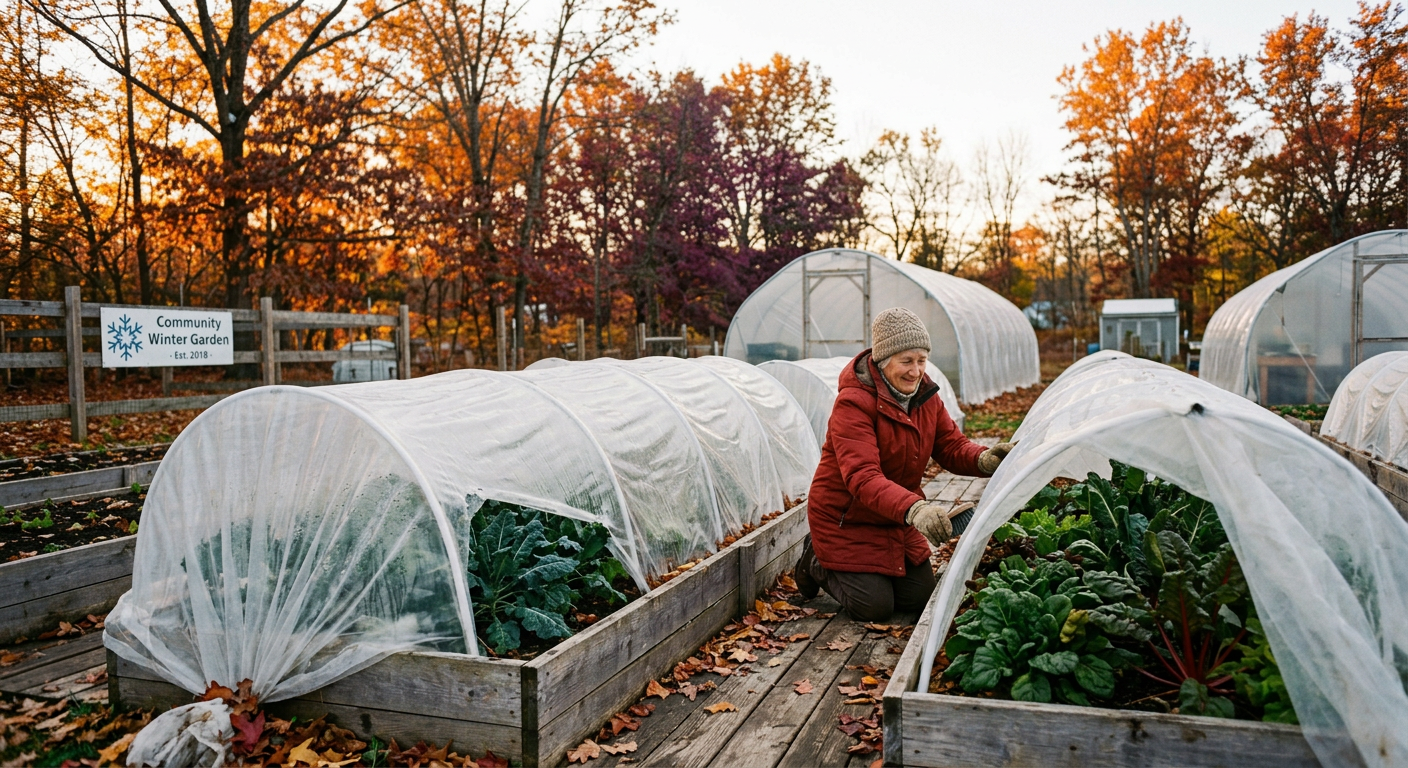
A dormant northeast garden — stripped of color and harvest — turns out to be one of the better teachers of presence: observing frost patterns, bare soil, and stillness trains the same attention muscle as formal meditation.
There’s a particular kind of clarity that comes from standing in a garden with nothing left to tend. No deadheading, no watering, no harvest to rush toward. In the northeast, that window — roughly November through March — strips the garden down to its structure: the geometry of raised beds, the tracery of bare stems, the way frost settles differently on compacted soil than on loose, aerated ground. Gardeners who’ve spent seasons trying to *do* something out there often find that the dormant garden resists that impulse entirely. It doesn’t ask you to fix it. And that resistance, it turns out, is worth something.
What you’re practicing when you walk a dormant garden with slow attention isn’t so different from what happens on a meditation cushion. Both ask you to stay with what’s actually there rather than what you’re waiting for. Noticing that the garlic you planted in October has sent up thin green spears despite the cold, or that the soil under the mulch is darker and more alive-smelling than the exposed patch beside it — these observations require the same quality of presence that formal mindfulness teachers call “beginner’s mind.” You’re not comparing this January to last January. You’re just here, in this light, with this frost. Jon Kabat-Zinn’s foundational work on mindfulness-based stress reduction describes attention training as the ability to notice what’s arising without immediately categorizing or reacting to it. The bare garden gives you something surprisingly good to practice on: change that’s real but slow, detail that rewards looking, and no urgency pushing you back inside.
There’s also something specifically useful about cold-season observation that warmer months don’t offer. When the garden is lush, attention scatters — there’s too much competing for it. But a dormant bed narrows the frame. You start to see frost patterns as data: where it lingers longest tells you something about drainage and shade; where it burns off first shows you your warmest microclimates. This is the same observational skill that experienced growers use to plan succession plantings and choose variety placements, but it’s also just — attention. Unhurried, low-stakes, genuinely interesting. The garden doesn’t care whether you call it meditation or not. It just keeps showing you what’s there.